 |
Under Water SLAM with Laser-light sectioning method using ST-GAT |
IntroductionThe demand for high-density and accurate 3D shape measurement of underwater scenes is rapidly growing for critical applications such as infrastructure inspection and marine resource exploration. However, the underwater medium poses unique challenges, such as light attenuation and scattering, which thwart conventional 3D sensing techniques. While multi-line laser systems offer a practical solution, they suffer from laser line fragmentation due to occlusion and scattering, leading to the failure of traditional ID assignment methods based on epipolar geometry.In this work, we reformulate the laser ID assignment problem as a graph-based sequence labeling task and propose a novel two-stage hierarchical framework using Spatio-Temporal Graph Attention Networks (ST-GAT). 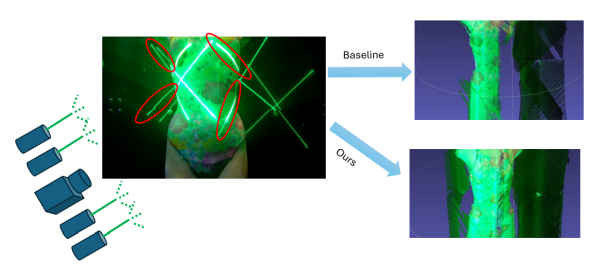
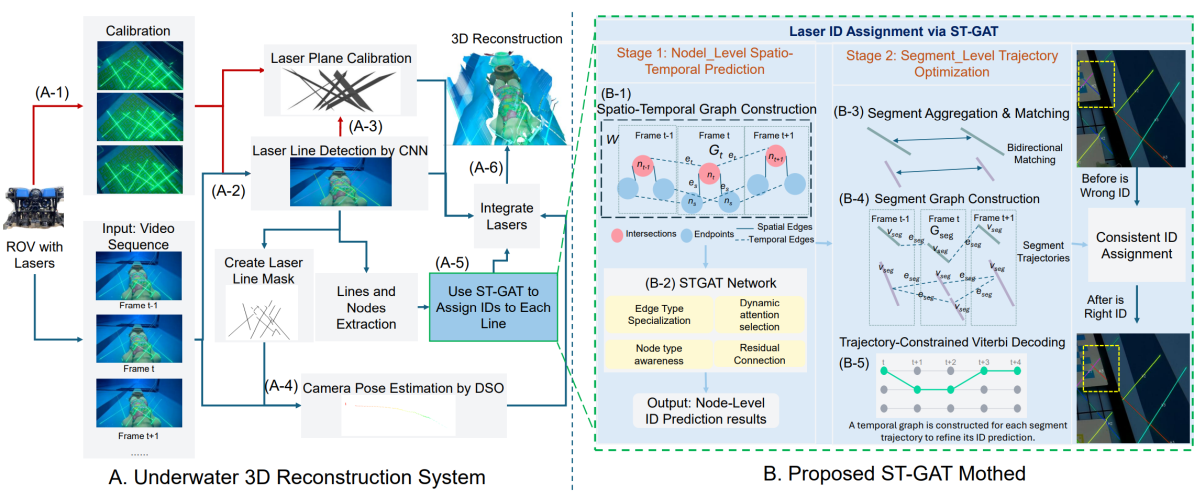
MethodologyOur core contribution is a robust GNN-based module for multi-line laser ID assignment. The proposed framework operates in two hierarchical stages to ensure both local topological correctness and global temporal consistency:
Experimental ResultsWe conducted comprehensive experiments in real underwater environments, including a clear pool and a scattering water tank. We compared our method against state-of-the-art passive methods (COLMAP, VGGT, 2DGS, WaterSplatting) and traditional active structured-light methods.As shown in the qualitative results below, our method demonstrates superior reconstruction completeness and temporal stability, especially in challenging environments where passive methods suffer from noise and traditional active methods fail due to data loss. Quantitative evaluations confirm that our approach achieves the best balance of accuracy and coverage. 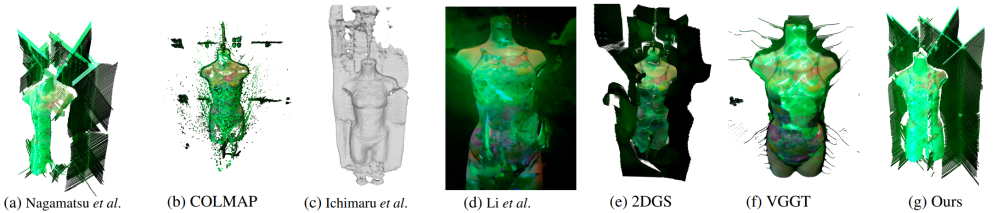
Resources
Publications
|
| Computer Vision and Graphics Laboratory |